
 Model Vehicles (498)
 Helmets (1)
 Showcases vetrina display box (6)
 Models cars (484)
 Models motorcycles motorbikes (3)
 Models trucks (9)
 Models trailers (1)
 Models airplanes aircrafts (1)
 Road street cars (399)
 Movie film cars (13)
 Concept cars – prototypes (2)
 Off-road vehicles SUV (12)
 Van minibus vehicles (8)
 Political cars (1)
 Police cars (8)
 Formula 1 F1 cars (25)
 Racing cars (6)
 Rally cars (10)
 Road street motorcycles motorbikes (3)
 Road street trucks (9)
 Military airplanes aircrafts (1)

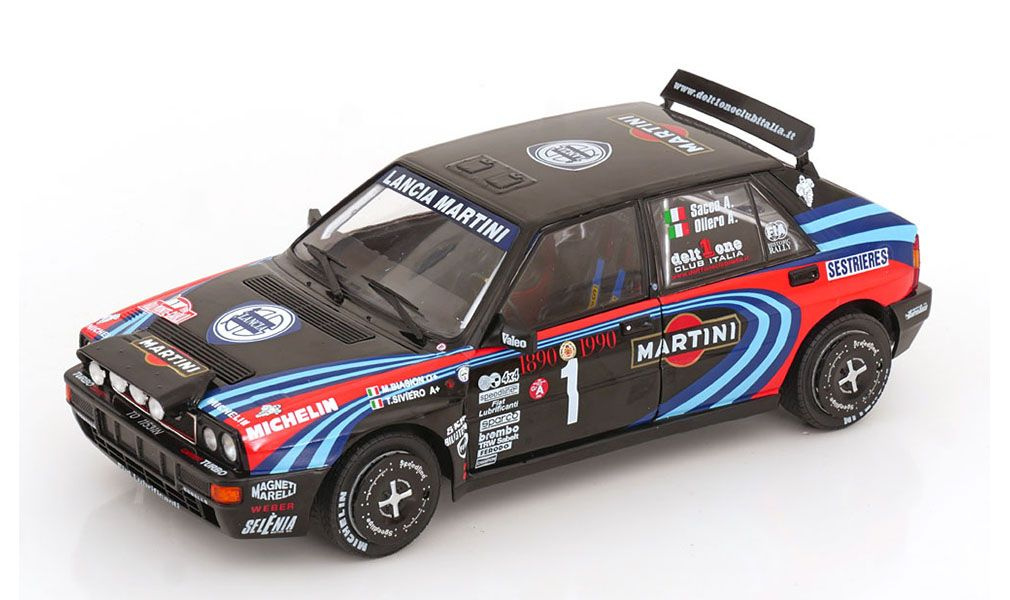
The Lancia Delta HF Integrale Evo 16V No. 1 Rally Monte Carlo 1990 Martini Racing, associated with legendary Italian rally driver Miki Biasion and co-driver Tiziano Siviero, represents one of the most recognizable symbols of the golden era of world rallying. This iconic car combines Italian automotive engineering, advanced all-wheel-drive technology, impressive performance, and the unmistakable Martini Racing livery. The 1:18 scale collectible model by Solido captures the distinctive appearance of this legendary rally car, making it an excellent choice for collectors, sports car enthusiasts, and anyone who appreciates automotive history.
The story of the Lancia Delta began in 1979, when it was introduced as a modern compact five-door car featuring practical bodywork and advanced engineering solutions. Thanks to Lancia’s ambitious motorsport program, the Delta soon became the foundation of one of the most successful competition cars in World Rally Championship history. Its development progressed from the Delta HF 4WD to increasingly sophisticated HF Integrale versions, including the 16-valve model introduced in 1989. Lancia’s Delta family achieved six consecutive World Rally Championship manufacturers’ titles from 1987 to 1992, securing its place among the greatest legends of motorsport.
The 1990 Lancia Delta HF Integrale 16V was powered by a transversely mounted four-cylinder turbocharged petrol engine with a displacement of 1,995 cc, or almost 2.0 litres. The engine featured double overhead camshafts, four valves per cylinder, electronic fuel injection, a turbocharger, and an intercooler. Depending on the road-going version and factory specification, power output was approximately 200 hp, while some technical references for Integrale 16V and Evoluzione versions quote around 205 hp. Maximum torque ranged from approximately 298 to 304 Nm, depending on the engine version and measurement method.
This powertrain delivered outstanding performance for a sports car from the late 1980s and early 1990s. Road-going versions could accelerate from 0 to 100 km/h in approximately 5.7–6.6 seconds, depending on the specification and test conditions, while top speed was around 220 km/h. These figures refer to road-going models and do not necessarily represent the No. 1 competition car entered in the 1990 Rally Monte Carlo, whose engine and other systems were prepared according to motorsport regulations. The combination of turbocharging, strong torque, and efficient power delivery helped make the Lancia Delta one of the most successful rally cars of its era.
The engine was paired with a five-speed manual gearbox designed for sporty driving and efficient use of the turbocharged engine’s power. Permanent all-wheel drive was one of the model’s most important technical advantages. The system featured a Ferguson viscous-coupling centre differential and a Torsen limited-slip rear differential. The torque distribution of the 16-valve version is commonly quoted at approximately 47 percent to the front axle and 53 percent to the rear. This configuration improved traction, stability, and handling, allowing the car to transfer power effectively on asphalt, snow, and gravel.
The suspension of the Lancia Delta HF Integrale 16V was developed to deliver precise handling, high-speed stability, and excellent cornering grip. Both the front and rear axles used independent suspension with MacPherson struts, coil springs, shock absorbers, and anti-roll bars. This design provided good body control and adaptability to different road surfaces. The wider track and flared wheel arches of later Evoluzione versions further enhanced the car’s aggressive stance and allowed for wider wheels and tyres. Competition versions featured suspension settings, wheel geometry, and damping specifically tailored to the requirements of each rally.
The braking system featured disc brakes on all four wheels, including ventilated front discs and ABS on applicable road-going versions. Combined with performance tyres and all-wheel drive, the system provided strong and controlled braking. Road-going models also featured power-assisted rack-and-pinion steering for precise handling. Rally cars received further modifications to their brakes, suspension, tyres, and steering systems, with different configurations available depending on the surface and competition regulations.
The road-going Lancia Delta HF Integrale 16V measured approximately 3,900 mm in length, 1,770 mm in width, and 1,365 mm in height, with a wheelbase of approximately 2,480 mm. Weight varied according to the version and equipment, with published specifications for different models generally indicating approximately 1,300–1,340 kg. Its compact dimensions, relatively short overhangs, and all-wheel-drive system contributed to its agility and stability, particularly on narrow mountain roads. Later Evoluzione versions received further improvements to the track width, bodywork, suspension, and brakes, giving the car an even more aggressive appearance and enhanced sporting capabilities.
Miki Biasion is one of the most important figures in the history of Lancia’s rally programme. He won back-to-back World Rally Championship drivers’ titles in 1988 and 1989, and his achievements are inseparable from the Delta Integrale and the legendary Martini Racing team. At the 1990 Rally Monte Carlo, Biasion and his co-driver Tiziano Siviero competed in a Lancia Delta Integrale 16V and finished third overall. The event took place from 19 to 25 January, with demanding stages combining asphalt, snow, and slippery mountain roads. Biasion completed the rally in 6 hours, 3 minutes, and 31 seconds, finishing 3 minutes and 39 seconds behind winner Didier Auriol, who also drove a Lancia Delta Integrale 16V.
Martini Racing livery became one of the most recognizable designs in motorsport history. The white bodywork with its distinctive blue, red, and light-coloured stripes, competition number 1, sponsor decals, and sporting details transformed the Lancia Delta into a car instantly recognizable to rally fans. The flared wheel arches, ventilated bonnet of the 16-valve version, sporty alloy wheels, aggressive bumpers, and rear spoiler emphasize its competition-inspired character. Road-going versions featured sports seats, driver-focused instruments, and a sporty steering wheel, while competition cars were equipped with additional safety and racing equipment, including a roll cage and specialized seats, in accordance with the relevant regulations.
The Lancia Delta HF Integrale was not a luxury car in the traditional sense. Instead, it was a performance-focused sports car whose main strengths were its engineering, driving dynamics, and rally heritage. Nevertheless, the quality equipment available on road-going versions, sporty interior, and exclusive character gave it a special status. Today, well-preserved examples are highly sought after by collectors, with originality, documented history, and rare factory specifications further influencing their value. Its reputation is built on genuine motorsport achievements and technical innovations that defined an entire generation of performance cars.
The Solido Lancia Delta HF Integrale Evo 16V No. 1 Rally Monte Carlo 1990 Martini Racing collectible model is produced in 1:18 scale, meaning it is approximately eighteen times smaller than the real car. This scale is especially popular among collectors because it allows the body proportions, competition markings, and distinctive design features to be reproduced in an attractive display format. The model stands out with its characteristic white bodywork, Martini Racing stripes, rally number 1, sporty wheels, and flared wheel arches that define the original car’s appearance.
Solido is known for producing collectible model cars that combine appealing styling, recognizable automotive licences, and good value for money. On this model, the body shape, distinctive front grille, sporty bumpers, competition livery, and overall proportions capture the character of the Lancia Delta. The 1:18 scale makes the details easy to appreciate when displayed in a cabinet, on a shelf, or as part of a dedicated rally car collection. The exact range of functional features, such as opening doors or bonnet panels, depends on the specific model version.
This model is more than a miniature representation of a sports car; it is also a reminder of an era when Lancia and Martini Racing helped shape the history of world rallying. Its connection with Miki Biasion, its association with the 1990 Rally Monte Carlo, and its legendary livery make it particularly appealing to motorsport enthusiasts. For collectors, it is an attractive addition to a collection of classic rally cars, while fans of Italian performance cars can display one of the most recognizable models in rally history.
The Solido Lancia Delta HF Integrale Evo 16V Martini Racing in 1:18 scale is also an excellent gift idea. It is an ideal present for Lancia fans, WRC enthusiasts, Martini Racing admirers, and lovers of classic sports cars, as well as collectors looking for an attractive model with a rich motorsport story. It is suitable for birthdays, Christmas, anniversaries, Father’s Day, and other special occasions. The model can serve as a striking decoration for an office, workspace, garage, or display cabinet, or as the starting point of a new model car collection.
If you are looking for a collectible model that combines legendary rally heritage, unmistakable Italian design, and attractive presentation, the Solido Lancia Delta HF Integrale Evo 16V No. 1 Rally Monte Carlo 1990 Martini Racing in 1:18 scale is an excellent choice. Its combination of sporting style, historical association with Miki Biasion, and the legendary Martini Racing team makes it a standout addition to any collection and a fantastic gift idea for automotive enthusiasts.