


 Helmets (1)
 Showcases vetrina display box (6)
 Models cars (474)
 Models motorcycles motorbikes (3)
 Models trucks (10)
 Models trailers (1)
 Models airplanes aircrafts (1)
 Road street cars (389)
 Movie film cars (13)
 Concept cars – prototypes (2)
 Off-road vehicles SUV (12)
 Van minibus vehicles (8)
 Political cars (1)
 Police cars (8)
 Formula 1 F1 cars (25)
 Racing cars (6)
 Rally cars (10)
 Road street motorcycles motorbikes (3)
 Road street trucks (10)
 Military airplanes aircrafts (1)
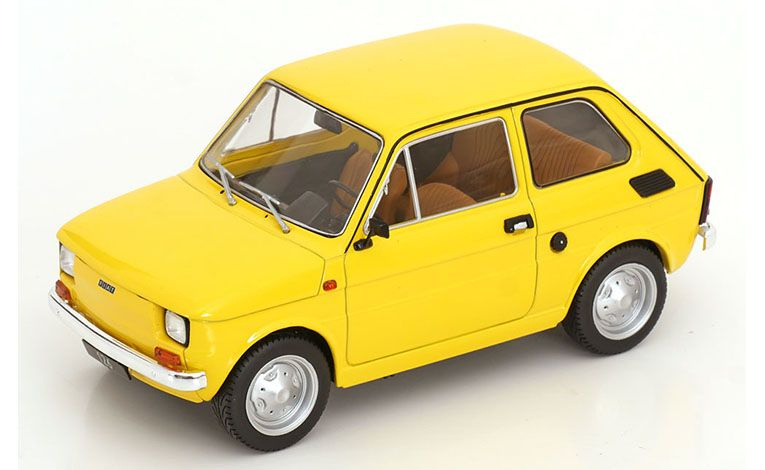
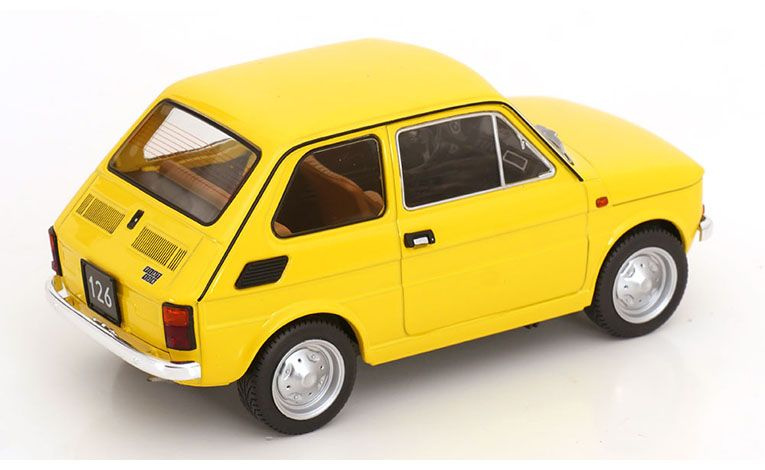
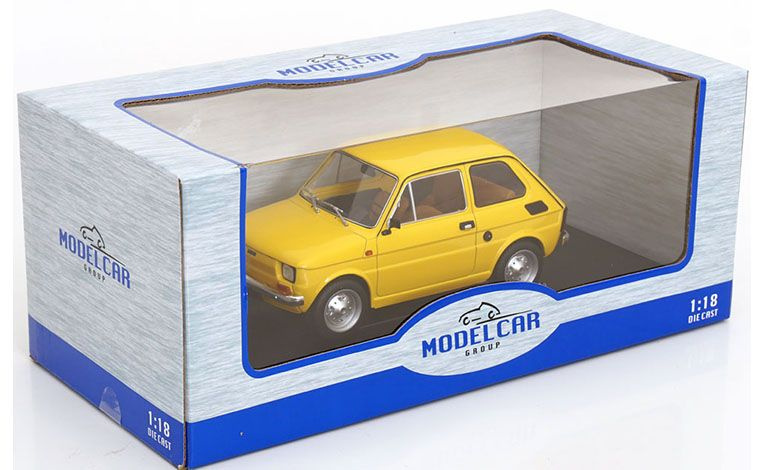
- Product SKU: MCG18667
- Producer: Model Car Group MCG
- Availability: Item available
;)
Fiat 126, known in Croatia and the countries of the former Yugoslavia by the charming nickname “Peglica”, is one of the most recognizable and beloved small cars to have shaped automotive history during the second half of the 20th century. Introduced in 1972 as the successor to the legendary Fiat 500, its compact dimensions, simple construction, rear-wheel drive and distinctive appearance quickly made it part of everyday life for generations of drivers. The Fiat 126 was produced in various versions and for different markets, and throughout its production it underwent numerous technical and structural changes. The period from 1972 to 1980 is particularly interesting because it covers the early versions of the original Fiat 126 and the development of the model during its first years of production.
The Fiat 126 was designed as a small, practical and economical car for everyday use. Its concept was simple yet highly effective: the engine was mounted at the rear, power was transferred to the rear wheels, and the body was extremely compact. The car had two side doors, four seats and a very low weight, making it ideal for city streets, narrow roads and parking in tight spaces. This simplicity became one of its greatest advantages.
The first versions of the Fiat 126 used a 594 cm³ two-cylinder, air-cooled petrol engine. The engine featured the classic configuration used for this type of compact car, with two cylinders and a total of four valves. Depending on the version and market, it produced approximately 23 hp at around 4,800 rpm, which was sufficient for the basic urban needs of a car weighing just over 600 kilograms. The engine's greatest strengths were its simplicity, durability and relatively small number of mechanical components.
During the later development of the Fiat 126, the engine capacity was increased to 652 cm³, improving its performance and everyday usability. This version also used a two-cylinder, air-cooled configuration, but the increased displacement provided slightly more torque and improved flexibility during normal driving. The development from 594 to 652 cm³ was one of the important technical steps in the history of the Fiat 126.
The engine of the Fiat 126 was mounted longitudinally at the rear of the vehicle, together with the transmission and drivetrain. This layout enabled a very simple transfer of power to the rear wheels while leaving sufficient space at the front of the car. Air cooling further simplified the design because there was no need for a conventional liquid-cooling system with a radiator, water pump and large quantity of coolant. As a result, the engine was relatively light, compact and easy to service.
For the early models, the 594 cm³ displacement and approximately 23 hp may seem modest by today's standards, but it is important to consider that the Fiat 126 was a very lightweight car. Depending on the version, its weight was approximately 600 to 650 kg, allowing the small two-cylinder engine to provide adequate performance for city and everyday driving. The focus was not on high top speed or sporty performance, but on economy, simplicity and reliability.
The engine used a carburetor, a conventional fuel-delivery system typical of cars from that era. There was no electronic fuel injection as found in modern vehicles. This made the mechanics of the Fiat 126 relatively simple, allowing owners to carry out maintenance and repairs more easily.
Power was transmitted through a four-speed manual gearbox. Four gears were more than adequate for the car's low weight and modest engine output. The gearbox was positioned together with the engine at the rear axle, with power delivered directly to the rear wheels. This layout created a compact drivetrain and contributed to the overall simplicity of the vehicle.
The four-speed manual transmission played an important role in making effective use of the small two-cylinder engine. First gear was designed for moving away from a standstill, while the higher gears allowed more economical driving at greater speeds. Because the car was so lightweight, there was no need for a large number of transmission ratios.
Rear-wheel drive is one of the key characteristics of the Fiat 126. Unlike many modern small cars with front-wheel drive, the Peglica transferred engine power to the rear wheels. The engine, gearbox and differential were located at the rear of the vehicle. This configuration was inherited from the concept of the Fiat 500 and made it possible to create an extremely compact car with a straightforward mechanical layout.
The suspension of the Fiat 126 was also designed around its low weight and simple construction. The front axle used independent suspension, while the rear suspension was designed around the rear-wheel-drive layout and rear-mounted engine. The suspension was simple and robust, which was important for a car intended for everyday use.
The front suspension used transverse components and a transverse leaf-spring element that served both as a spring and as part of the suspension structure. At the rear, the design accommodated the driven half-shafts and rear-mounted engine. Such solutions may appear very simple today, but they were characteristic of small European cars of the period.
The braking system was also very straightforward. The Fiat 126 used a hydraulic braking system, with disc brakes at the front and drum brakes at the rear. This combination was common among small cars of the era. The front discs provided more effective heat dissipation and braking performance, while the rear drums were simple, durable and sufficiently effective for a vehicle weighing around 600 kilograms.
Given the car's low weight, the braking system did not need to be engineered like that of a large or high-performance vehicle. The Fiat 126 was not designed for high speeds, so the combination of front discs and rear drums suited its intended purpose. The simple brake design also meant easier maintenance and relatively low servicing costs.
The steering system did not have power assistance, which was completely normal for a small car of the period. Due to its very low weight and compact dimensions, the driver did not require hydraulic or electric power steering. The manual steering was simple, mechanically direct and easy to operate at urban speeds.
The Fiat 126 was approximately 3,054 mm long, around 1,378 mm wide and approximately 1,300 mm high, depending on the version and model year. Its wheelbase was around 1,840 mm. These dimensions clearly demonstrate just how compact the car was. With a length of just over three metres, it could be parked in spaces where a larger vehicle would have struggled.
The vehicle's weight varied depending on the version, but generally ranged from approximately 600 to 650 kg. This low weight was one of the Fiat 126's greatest advantages. The small engine did not have to move a heavy vehicle, the brakes did not have to stop a large mass, and the suspension could remain simple and lightweight. This philosophy resulted in a car that was relatively economical and easy to operate.
The fuel tank had a capacity of approximately 30 litres, which was sufficient for a vehicle primarily intended for city and short-distance driving. Thanks to its low weight and small two-cylinder engine, fuel consumption was one of its important advantages. The Fiat 126 was known as a car that did not require large amounts of fuel for everyday use.
The small body did not mean that the car was completely impractical. Despite its exterior dimensions, the Fiat 126 had four seats and could transport a small family. The front section of the car provided luggage space, while additional space was available at the rear depending on the version and how the vehicle was used. For a car measuring just over three metres in length, this was a very practical solution.
The equipment of the Fiat 126 was simple and functional, reflecting the era in which the car was created. It was not intended as a luxury vehicle but as an affordable means of transportation. The dashboard contained the basic instruments required by the driver, including a speedometer and essential warning lights. The interior was simple, clear and focused on practicality.
Depending on the production year and specific version, the Fiat 126 could feature different equipment details, including various seat designs, door trim, steering wheels, dashboards, bumpers and lighting components. This is why small differences can be found between individual model years and market versions. Early models are particularly interesting to collectors because they represent the original form of the Fiat 126 from its first years of production.
The design of the Fiat 126 was simple yet highly recognizable. The body featured rounded edges, short overhangs, a narrow cabin and a distinctive rear section. The front and rear lights, small bumpers, chrome details and compact silhouette create an appearance that is instantly associated with the name Peglica.
In Croatia and neighbouring countries, the nickname “Peglica” became almost synonymous with the Fiat 126. For decades, the car was part of everyday traffic, and many families remember it as their first car or as the vehicle they grew up with. For this reason, the Fiat 126 has a special sentimental value today. For many automotive enthusiasts, it is not simply a technical object but a reminder of a particular era, family life, first drives and simpler times.
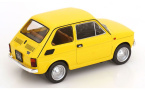
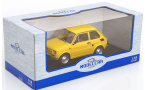
This collectible model represents the Fiat 126 Peglica in 1:18 scale, also written as 1/18, and was produced by the licensed manufacturer Model Car Group, known as MCG. The 1:18 scale is one of the most popular scales among collectors because it allows the distinctive proportions of the vehicle and numerous details to be represented in a sufficiently large format.
Model Car Group MCG is known for producing collectible vehicle models intended for automotive enthusiasts and collectors. In 1:18 scale, the proportions of the body, roof shape, doors, windows, lights, wheels and other exterior details can be particularly well appreciated. The larger format allows the distinctive appearance of the Fiat 126 to stand out beautifully.
This Fiat 126 Peglica is especially attractive in its original yellow vehicle colour. The yellow finish perfectly emphasizes the car's retro character and gives the model a cheerful and nostalgic appearance. Combined with the compact body, chrome details and unmistakable Fiat 126 design, the yellow version immediately attracts attention in any collection.
The model is an excellent choice for display in a cabinet, on a shelf, desk, in an office or in a space decorated in a retro or automotive style. The 1:18 scale makes the model large enough to be eye-catching while remaining compact enough for convenient display.
The Fiat 126 Peglica MCG 1:18 is particularly appealing to collectors who appreciate classic cars, vintage vehicles, automotive history and models with strong nostalgic value. Unlike modern sports cars, the Peglica's appeal comes from its simplicity, charming design and the memories it evokes for generations of people.
This model can be an excellent gift for someone who once owned a Fiat 126, drove a Peglica or associates this little car with special memories. It can also be a thoughtful gift for parents, grandparents, friends, collectors or anyone who appreciates classic Fiat automobiles.
A particularly meaningful idea is to give this model as a wedding anniversary gift. The Fiat 126 Peglica can symbolize a shared life, journeys, family and memories from earlier times. For a married couple who remembers their first cars, shared trips or the period when the Fiat 126 was part of everyday life, such a gift can have much greater emotional value than an ordinary decorative item.
As a wedding anniversary gift, the yellow Fiat 126 Peglica MCG 1:18 can be especially meaningful because it carries a story. It is a car that can evoke memories of simpler times, first drives, family trips and shared moments. The model can become a lasting keepsake displayed in a cabinet for years, serving as a reminder of a special period in a couple's life.
The Fiat 126 Peglica MCG 1:18 is also an excellent choice as a classic car gift, a gift for a collector, a gift for a Fiat enthusiast, a gift for parents or an original present for someone who appreciates retro design. Its yellow colour, compact silhouette and recognizable details make it stand out from traditional sports and luxury cars in a collection.
The real Fiat 126 was a simple car, but that simplicity was precisely what made it so special. The early 594 cm³ two-cylinder engine, later increased to 652 cm³, approximately 23 hp, four-speed manual gearbox, rear-wheel drive, rear-mounted engine, front disc and rear drum brakes, simple independent front suspension, low weight of approximately 600 to 650 kg and length of just over three metres create a technical story that remains interesting today precisely because of its simplicity.
The Fiat 126 Peglica MCG 1:18 therefore represents a combination of automotive history, nostalgia, quality collectible craftsmanship and emotional value. Its original yellow colour, recognizable design and 1:18 scale make it an attractive addition to any collection, while the story behind the real car gives the miniature additional meaning.
Whether purchased as a collectible model, a display piece or a special gift, the Fiat 126 Peglica MCG 1:18 represents a small piece of automotive history that will especially delight lovers of classic cars. As a wedding anniversary gift, this charming yellow Peglica can also serve as a beautiful symbolic reminder of the years spent together, shared journeys and all those little moments that together create a great life story.
Production year of vehicle and equipment: 1972
Scales and sizes: 1:18 1/18
Model length: 17,00 centimeters
Material type: metal road street car
Product features:
- very authentic exterior
- very authentic interior
- all the wheels turn, and the front wheels rotate
- nothing opens
- model car comes on base in very quality packaging
- high quality of production
We can source any model vehicle outside of our current offer
If you're looking for specific model vehicle that are not currently visible in our online store, feel free to send us an inquiry at info@modelcarsgifts.eu
Products carefully packaged and protected during shipping
When packing your products, we use high-quality protective materials to ensure they arrive at your address undamaged.
Reliable support for our customers at all times
If you have any questions or concerns, don’t hesitate to reach out to us at info@modelcarsgifts.eu
100% secure shopping
We use the latest data protection standard, Secure Socket Layer (SSL), to ensure that our customers’ payments are extremely secure.
Related products
 Model Vehicles
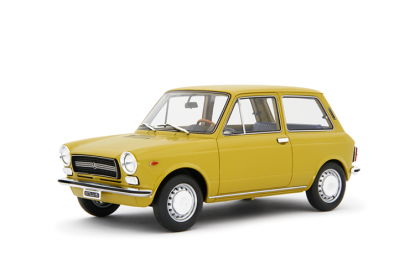
1:18 1/18 Autobianchi A112 Series 1 1969 1973 senape yellow Laudoracing-Models
 Model Vehicles
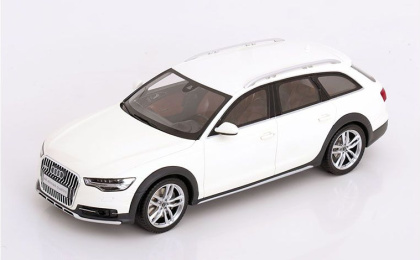
1:18 1/18 Audi C7 A6 All Road Avant Quattro SW Station Wagon 2015 2018 white Otto-Mobile
 Model Vehicles
1:18 1/18 Dacia Duster Extreme TCE 130 4X4 2024 today beige sandstone Otto-Mobile
 Model Vehicles
1:18 1/18 Maserati Quattroporte Series 3 Limousine 1979 1985 silver Cult-Scale Models