


 Helmets (1)
 Showcases vetrina display box (6)
 Models cars (474)
 Models motorcycles motorbikes (3)
 Models trucks (10)
 Models trailers (1)
 Models airplanes aircrafts (1)
 Road street cars (389)
 Movie film cars (13)
 Concept cars – prototypes (2)
 Off-road vehicles SUV (12)
 Van minibus vehicles (8)
 Political cars (1)
 Police cars (8)
 Formula 1 F1 cars (25)
 Racing cars (6)
 Rally cars (10)
 Road street motorcycles motorbikes (3)
 Road street trucks (10)
 Military airplanes aircrafts (1)
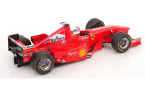
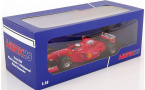
- Product SKU: W18033001
- Producer: Werk83
- Note: Winner GP Montreal, Canada, driver Michael Schumacher
- Availability: Item available
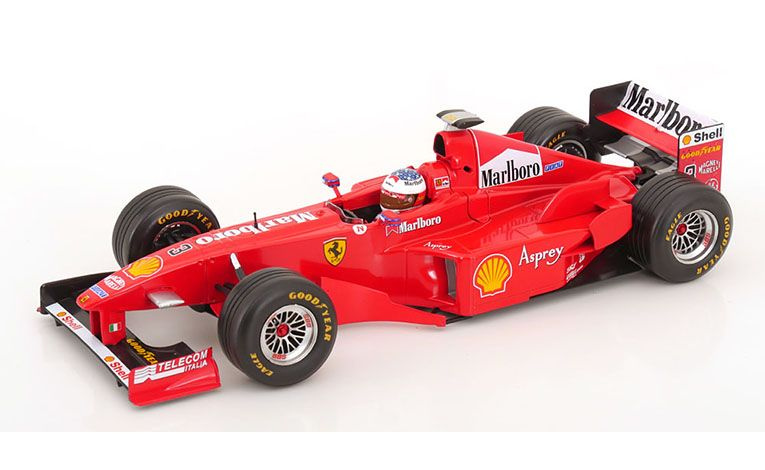
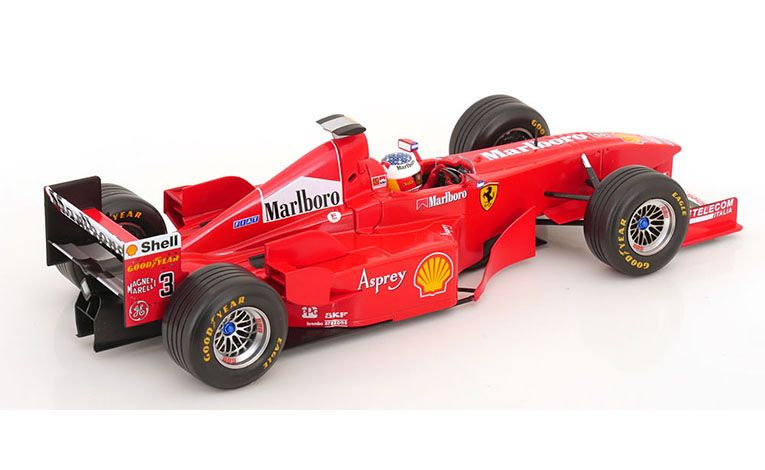
The Ferrari F1 F300 in 1:18 scale (1/18), produced by WERK83, is an attractive and highly detailed collectible model of the legendary Ferrari Formula 1 car from the 1998 season, driven by Michael Schumacher to victory at the Canadian Grand Prix in Montreal. This Ferrari F300 #3 represents one of the significant cars from Schumacher’s Ferrari career and is sure to appeal to Formula 1 fans, Ferrari enthusiasts, Michael Schumacher admirers, and collectors of historic racing cars. The 1998 Canadian Grand Prix was held at the challenging Circuit Gilles-Villeneuve in Montreal, where Michael Schumacher crossed the finish line first after 69 laps with the Ferrari F300. Its connection to a race-winning Formula 1 car gives this WERK83 miniature a special place among Ferrari F1 models.
The 1:18 scale model faithfully recreates the distinctive appearance of the original Scuderia Ferrari Formula 1 car. The iconic Ferrari red livery, race number 3, aerodynamic bodywork, cockpit, wheels, wings, and Marlboro and Shell sponsor markings give the model an authentic appearance inspired by Ferrari’s golden era of Formula 1. Particular attention is drawn to the precisely shaped aerodynamic components and bodywork details that were essential to the performance of the original F300. Thanks to the high-quality craftsmanship of WERK83, the model makes an impressive display piece in a collector’s cabinet, on a shelf, or in a dedicated motorsport collection.
At the heart of the Ferrari F300 was the Ferrari Tipo 047, a naturally aspirated 3.0-liter V10 engine. The power unit featured ten cylinders arranged in a V configuration and developed approximately 800 hp. The engine could reach around 17,000 rpm, producing the distinctive high-revving V10 sound that became one of the defining characteristics of one of the most iconic eras in Formula 1 history. For motorsport enthusiasts, this naturally aspirated V10 engine is one of the main reasons why the Ferrari F300 continues to hold a special place in racing history.
The Ferrari Tipo 047 was fundamentally different from today’s Formula 1 power units. It did not use a turbocharger or electric hybrid assistance, instead producing its power through naturally aspirated induction and extremely high engine speeds. Such a design required exceptionally precise engineering of the pistons, valves, camshafts, fuel-injection system, and lubrication system. At nearly 17,000 rpm, the engine’s internal components had to withstand enormous mechanical loads, requiring advanced materials and extremely precise manufacturing tolerances.
The engine was mounted longitudinally in the rear of the car and played an important structural role in the overall architecture of the Ferrari F300. The rear suspension, gearbox, and other components were integrated with the powertrain to create a compact and lightweight package. This layout contributed to an efficient distribution of mass between the front and rear axles and helped provide stability at high speeds.
Ferrari also had to devote considerable attention to the engine cooling system. An engine producing approximately 800 hp at extremely high rpm generates a tremendous amount of heat. The cooling system had to maintain optimum engine temperatures throughout the race, while the side air intakes and radiators had to be designed to provide sufficient airflow without unnecessarily increasing aerodynamic drag. The lubrication system was equally important, as the engine and its moving components required a constant and precisely controlled supply of oil at very high engine speeds.
Power from the Ferrari F300 was delivered to the rear wheels through a 7-speed sequential semi-automatic gearbox. This advanced transmission system allowed Michael Schumacher to change gears extremely quickly using controls mounted on the steering wheel. The driver did not need to operate a conventional manual gear lever, allowing rapid gear changes with minimal loss of time and without taking his hands away from the steering wheel.
The seven-speed gearbox allowed the wide power band of the V10 engine to be used efficiently. Lower gears were optimized for strong acceleration out of slower corners, while the higher gears allowed the car to reach high speeds along long straights. Electronic control of the gearbox was integrated with engine management to make gear changes as fast, precise, and reliable as possible. This technology represented one of the advanced features of Formula 1 cars during the late 1990s.
The gearbox also had to be extremely compact and lightweight, as every additional kilogram could negatively affect the car’s performance. Its casing and internal components were engineered to withstand the enormous forces generated during rapid gear changes and hard acceleration. Combined with the high-revving V10 engine, the 7-speed sequential gearbox allowed the F300 to transfer its available power to the rear wheels with exceptional efficiency.
The Ferrari F300 braking system represented another outstanding technological element of the car. The Formula 1 machine used high-performance carbon brake discs and pads specifically developed to withstand the extreme conditions of Grand Prix racing. Carbon braking components provided outstanding performance at temperatures that would be excessive for conventional automotive braking systems.
During heavy braking from high speeds, the carbon discs had to convert an enormous amount of kinetic energy into heat within a very short period. As a result, brake temperature management was critically important. The braking system had to provide maximum stopping power, precise pedal feel, and sufficient stability to allow Schumacher to brake extremely late while accurately positioning the car before entering a corner.
The Circuit Gilles-Villeneuve in Montreal placed particularly high demands on the braking system because its long straights were followed by demanding heavy-braking zones. Brake performance and reliability were therefore essential to achieving victory. Michael Schumacher’s precise braking technique allowed him to exploit the full potential of the Ferrari F300 and maintain effective control of the car throughout the race.
The suspension of the Ferrari F300 was developed to provide maximum mechanical grip while maintaining aerodynamic efficiency. Both the front and rear suspension used an independent double-wishbone layout with push-rod systems. Springs and dampers were positioned inside the bodywork to reduce their aerodynamic impact and improve airflow around the car.
The push-rod suspension system allowed Ferrari engineers to precisely adjust the car’s characteristics according to the demands of each circuit. Spring stiffness, damper settings, ride height, suspension geometry, and numerous other parameters could be carefully optimized. At the Montreal circuit, achieving the right balance between high-speed stability, heavy braking performance, and the ability to handle bumps and kerbs was particularly important.
The suspension had to be sufficiently compliant to keep the tires in contact with the track over uneven surfaces, while remaining firm enough to keep the body stable under heavy braking and high aerodynamic loads. This ability to precisely tune the suspension was one of the key advantages of advanced Formula 1 cars of the period.
The Ferrari F300 chassis was built around a lightweight carbon-fiber monocoque and composite materials incorporating an aluminum honeycomb structure. The carbon-fiber construction provided exceptional rigidity while keeping weight to a minimum. At the same time, the monocoque formed a protective survival cell around the driver in the event of an accident. Every component had to meet strict Formula 1 safety requirements while remaining as lightweight as possible to maximize performance.
Aerodynamics were a crucial aspect of the Ferrari F300 and the result of intensive development and testing. The front wing, rear wing, floor, diffuser, side air intakes, and bodywork worked together to generate the aerodynamic downforce required for high cornering speeds. At the same time, aerodynamic drag had to be controlled to allow the car to achieve high top speeds on the straights.
The technical regulations introduced for the 1998 season had a significant influence on the aerodynamic design and handling characteristics of Formula 1 cars. The F300 used grooved tires instead of fully slick tires, reducing mechanical grip and increasing the importance of finding the correct aerodynamic setup. Ferrari engineers therefore had to achieve an optimal balance between downforce, drag, grip, and stability.
The underbody of the car also played an important role. Airflow beneath the car contributed to aerodynamic downforce, while the rear diffuser helped manage the airflow exiting from underneath the vehicle. Every element of the bodywork was shaped to guide the air as efficiently as possible around and beneath the car. The side air intakes simultaneously had to provide sufficient airflow for cooling the engine and other components without creating unnecessary aerodynamic drag.
The F300 was also equipped with sophisticated engine and gearbox management systems. Electronic control enabled precise management of the power unit, gear changes, and various operating parameters. Although the technology was less advanced than the systems found in modern Formula 1 cars, it represented highly sophisticated engineering for the late 1990s.
The cockpit was extremely compact and designed around the ergonomics and requirements of the driver. Michael Schumacher sat in a deeply positioned racing seat surrounded by the steering wheel and controls he needed to operate throughout the race without losing concentration. The steering wheel incorporated gear-change controls and other important functions, while the instrumentation allowed the driver to monitor critical operating parameters.
Radio communication with the team was another important part of the car’s equipment. During the race, Schumacher could receive information from the pit wall regarding strategy, tire condition, traffic, and other important race situations. At the same time, the team monitored the engine, gearbox, tires, temperatures, and other critical systems and could adjust the race strategy when necessary.
The car featured advanced cooling, fuel delivery, lubrication, and electronic management systems that had to operate reliably throughout the entire Grand Prix. Fuel was stored in a safety fuel cell positioned behind the driver within the monocoque, while the arrangement of the major components was optimized to achieve an effective weight distribution.
The defining feature of this collectible Ferrari F300 version is its connection with Michael Schumacher and his victory at the 1998 Canadian Grand Prix. Schumacher started the Montreal race from third position and completed all 69 laps to take victory. The result was an important achievement in his championship campaign and further established the Ferrari F300 as one of the most recognizable Ferrari Formula 1 cars of the late 1990s.
WERK83 presents this historic Formula 1 car in the popular 1:18 scale. The model has been created with particular attention to the recognizable details of the original Ferrari F300, including the body shape, front and rear wings, side air intakes, wheels, suspension, cockpit, and iconic Ferrari red livery. The race number 3 and Michael Schumacher driver figure further emphasize the connection between the model and the specific race-winning Ferrari.
The high-quality craftsmanship of the WERK83 model is particularly evident in its accurately shaped body lines, aerodynamic details, and overall representation of the original Formula 1 car. The 1:18 scale allows many details that would be difficult to appreciate on smaller models to be clearly visible. This makes the model an excellent choice for serious collectors looking for a highly representative Ferrari F300 miniature.
The 1:18 scale, also known as 1/18 scale, is one of the most popular scales among model car collectors because it offers an excellent balance between model size and level of detail. The Ferrari F300 is large enough for its characteristic aerodynamic elements, suspension, wheels, cockpit, and body lines to be clearly appreciated, while remaining compact enough to display in a cabinet, on a shelf, desk, or in a dedicated collector’s room.
The Marlboro and Shell sponsor markings further enhance the authenticity of the model and recall the distinctive visual identity of Scuderia Ferrari in 1998. The combination of Ferrari red, race number 3, Marlboro and Shell markings, the Michael Schumacher driver figure, and the unmistakable F300 silhouette makes this model especially appealing to fans of Ferrari Formula 1 history.
The Ferrari F1 F300 1:18 WERK83 Michael Schumacher Canadian Grand Prix 1998 is an excellent choice for model car collectors, Formula 1 enthusiasts, Ferrari fans, and Michael Schumacher admirers. This collectible model combines a historic Montreal victory with the legendary Ferrari F300, naturally aspirated V10 engine, 7-speed semi-automatic gearbox, carbon brakes, advanced push-rod suspension, sophisticated aerodynamics, and the distinctive equipment of a late-1990s Formula 1 car.
If you are looking for unique gifts for a Formula 1, Ferrari, or Michael Schumacher fan, the Ferrari F300 1:18 by WERK83 is an excellent choice. This collectible model makes a special gift for a birthday, anniversary, special occasion, or simply as a valuable addition to the collection of a true motorsport enthusiast. The combination of the race-winning Ferrari F300, Michael Schumacher, the 1998 Canadian Grand Prix, the legendary V10 engine, iconic Ferrari livery, Marlboro and Shell sponsor markings, and the high-quality craftsmanship of WERK83 makes this model much more than an ordinary miniature. It represents a piece of Formula 1 history and an impressive collectible that will be especially appreciated by true Ferrari F1 enthusiasts.
Production year of vehicle and equipment: 1998
Scales and sizes: 1:18 1/18
Model length: 24,10 centimeters
Material type: metal Formula 1 F1 car
Product features:
- very authentic exterior
- very authentic interior
- all the wheels turn, and the front wheels rotate
- nothing opens
- with the F1 car model comes a figure of the driver Michael Schumacher in a sitting position in bolide
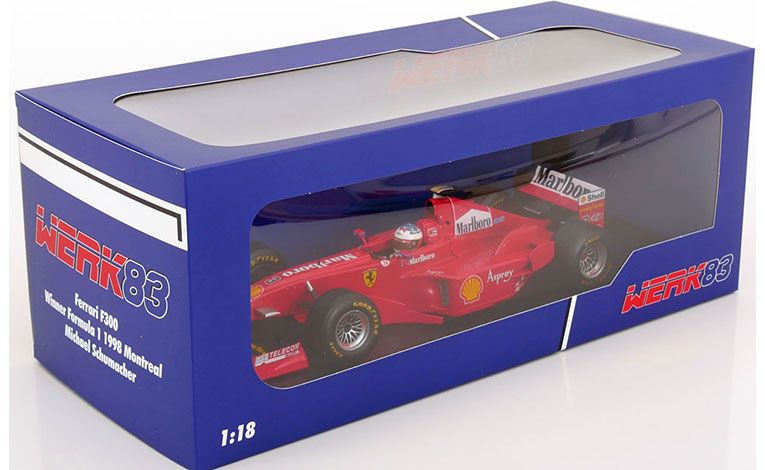
- model Formula 1 F1 car comes in quality packaging
- high quality of production
We can source any model vehicle outside of our current offer
If you're looking for specific model vehicle that are not currently visible in our online store, feel free to send us an inquiry at info@modelcarsgifts.eu
Products carefully packaged and protected during shipping
When packing your products, we use high-quality protective materials to ensure they arrive at your address undamaged.
Reliable support for our customers at all times
If you have any questions or concerns, don’t hesitate to reach out to us at info@modelcarsgifts.eu
100% secure shopping
We use the latest data protection standard, Secure Socket Layer (SSL), to ensure that our customers’ payments are extremely secure.
Related products
 Model Vehicles
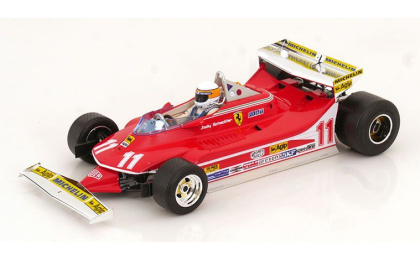
1:18 1/18 Ferrari F1 312 T4 Sieger No 11 Winner GP Monaco Jody Scheckter 1979 red Bburago
;)
 Model Vehicles
1:18 1/18 Mercedes W29 500K Special Cabriolet 1936 1940 grey Maisto
 Model Vehicles
1:18 1/18 Chevrolet Caprice Texas Police Department 1987 1989 white black Greenlight